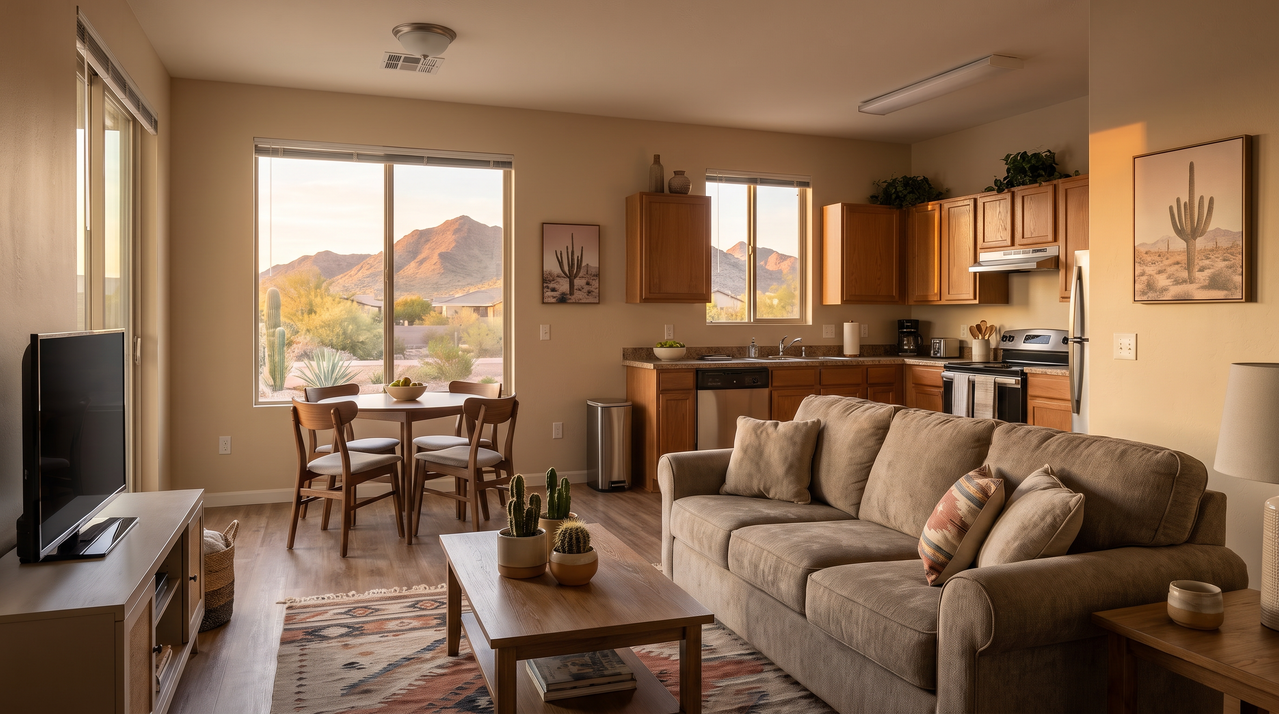
A rented apartment in Tucson, Arizona
Home / Renters Insurance

You don't own the building. You own everything in it.

Your landlord's policy covers their walls. Yours covers your life. About $12 a month in Arizona, and we can have proof to your landlord today.

~$15/mo
Typical CA Premium
44%
Of Arizonans Rent
1 in 2
Renters Carry Nothing
Same Day
Proof To Your Landlord
The Quick Answer

Arizona does not require renters insurance, but your lease probably does, and most Southern Arizona property managers ask for $100,000 to $300,000 in liability with the landlord added as an additional interest. It runs about $12 to $25 a month and covers four things: your belongings (including things stolen from your car, which auto insurance does not cover), loss of use if your unit becomes uninhabitable, personal liability, and medical payments for guests. Your landlord's policy covers the building only, never your belongings or your liability. Roommates need their own policies. Earthquake and flood are excluded and written separately, though renters earthquake coverage is unusually cheap. Raquel Jimenez Insurance in Tucson quotes it free and can send proof to your landlord the same day at (520) 889-5766.

Typical cost
$12 to $25 a month
Required by
Your lease, not Arizona law
Landlord's policy
Covers the building, not your things
Free quotes
(520) 889-5766
Arizona Renters Insurance, The Short Version

The cheapest policy in insurance. And half of Arizona renters skip it.

Roughly 44 percent of Arizonans rent, more renters than any other state, and about half of those households carry no renters insurance at all. The usual reasons are that it seems like an expense for people with more stuff, or that the landlord surely has it covered. Neither survives contact with an actual claim.

Here is the honest math. A policy runs about $12 to $25 a month. Add up what is in your apartment at replacement prices: the mattress, the couch, the desk, every screen, the kitchen, the closet, the bike. Most people land somewhere north of $30,000 and are startled by their own list. That is what you are protecting for roughly the price of one lunch a month.

Then there is the part nobody mentions: liability. Your policy is not really about your couch. It is about the day your bathtub overflows into the two units below, or your dog bites someone at the park, or a friend gets hurt in your kitchen. Those become five and six figure problems attached to your name, and they are the reason your lease requires coverage in the first place. Your landlord is not protecting you, they are protecting themselves from you.

And the quiet kicker: bundling renters with your auto policy often knocks more off the auto premium than the renters policy costs. Done right, you can end up protecting everything you own for roughly nothing. That is not a sales line, it is just how the discount stacks. Call and we will price both and show you the two numbers side by side.
Four coverages. And the things people assume are covered but aren't.

A renters policy, technically an HO-4, does four jobs. The exclusions are just as worth knowing as the coverages.

Coverage C
$20k to $50k

Personal Property

Everything you own, and it follows you: your belongings are covered in your unit, in your car, at the gym, and on vacation. Jewelry, watches, and cameras carry sub-limits around $1,500 to $2,500, so anything meaningful gets scheduled separately.

Coverage D
Real Rent

Loss of Use

Pays for somewhere to live when your unit is uninhabitable after a covered loss. In a market where your six-year-old rent is nowhere near today's asking price, this limit deserves an actual look instead of the default.

Coverage E
$100k to $500k

Personal Liability

The real reason your lease requires this. Covers you when you injure someone or damage their property, including the overflowing tub into the unit below, plus legal defense. Follows you off the property too.

Coverage F
$1k to $5k

Medical Payments

Pays a guest's minor medical bills regardless of fault, no lawsuit needed. Small limits, small cost, and it settles the kind of thing that would otherwise turn into a liability claim against you.

Not covered
The Walls

The Building Itself

Roof, plumbing, structure, and common areas belong to your landlord's policy. Their policy covers their asset and does nothing for you. This is the assumption that costs people the most.

Not covered
Roommates

Your Roommate's Stuff

A standard policy covers you and a spouse or domestic partner. A roommate on the same lease is not covered by your policy. Everyone needs their own, which also means nobody's claim eats someone else's limit.

Not covered
Earthquake

Earthquake

Excluded by default and added separately. For renters it is unusually cheap, because you are insuring your belongings and your housing costs rather than a building. On this fault network, ask about it.

Not covered
Flood

Flood

Rising water from outside needs separate flood coverage. Water from inside the building, a burst pipe or the upstairs tub, is sudden and accidental, and that is covered.

Not covered
Your Car

The Vehicle Itself

The car is your auto policy's job. But what was inside the car when the window went is a renters claim. The two policies hand off to each other, which is exactly why bundling them makes sense.

Need proof of insurance before you sign the lease?

We do this constantly and it is usually same-day. We will add your landlord as additional interest and send the certificate straight to them.

Coverage Basics

The four things worth getting right on a $15 policy.

It is cheap enough that most people buy the first thing they are offered. These are the choices that separate a policy that works from a policy that technically exists.

1. Replacement cost, not actual cash value

This is the most important line on a renters policy, and it is a checkbox. Replacement cost pays what it takes to buy a new equivalent today. Actual cash value pays what your stuff is worth used, which is almost nothing. Your four-year-old laptop is worth maybe $300 at cash value and $1,400 to replace.

The upgrade to replacement cost costs a few dollars a month and roughly doubles what the policy is worth to you at claim time. If your current policy is actual cash value, that is the first thing we fix.

2. Liability, sized to the damage you could actually cause

Renters default to $100,000, which is what most leases require, and it is thinner than it sounds. One overflowing tub in a stacked apartment building can damage several units. A dog bite claim regularly clears six figures.

Moving from $100,000 to $300,000 or $500,000 usually costs a few dollars a month. Measured in dollars of protection per dollar of premium, it is the best buy on the page, and it is the coverage most likely to be the reason you were glad you had a policy.

3. Loss of use, sized to today's rent

Loss of use pays the gap between your normal housing cost and what you are forced to spend after a covered loss. In Tucson that gap can be brutal. If you have held an apartment for six years, your rent is well under the current market rate, and being displaced tomorrow means renting at today's prices for months while your building is repaired.

This is the coverage that quietly matters most in an expensive rental market, and it is the one nobody reads. We will check that the limit reflects what your neighborhood actually costs now.

4. Scheduling the things that matter

An engagement ring, a camera kit, a good bike, a musical instrument, a watch that meant something. Standard sub-limits cap these around $1,500 to $2,500 no matter how much total coverage you carry, so a $6,000 ring is a $1,500 claim.

Scheduling an item lists it individually at an agreed value, usually removes the deductible for that item, and broadens the covered causes to include simply losing it. It costs very little. Bring us the appraisal or the receipt and we will add it.

Already have a policy? Let us read it with you.

Replacement cost or cash value, liability limit, loss of use, sub-limits on the ring. Four things, five minutes, no charge and no pitch.

Six ways to pay even less. On something already cheap.

The first one is the whole game: bundling with auto often saves more on the car than the renters policy costs. The rest are small, but they stack.

1

Bundle with your auto policy

The discount on the auto side frequently exceeds the entire renters premium, which means the coverage effectively pays for itself. This is the single best value in personal insurance and it takes one phone call. Start with an auto quote and we will price the pair together.

2

Take the deductible you can actually cover

Moving from $500 to $1,000 trims the premium. On a policy this cheap the savings are modest, so only do it if you could write that check tomorrow without stress. Do not raise the deductible past your emergency fund to save $30 a year.

3

Claim the building's safety features

Sprinklers, monitored alarms, smoke detectors, secured entry, a gated garage. Many apartment buildings have several of these and most renters never mention them. They are worth real percentage points.

4

Pay in full and go paperless

Small, boring, automatic. Paying annually rather than monthly avoids installment fees, and both discounts apply to almost everyone who asks for them.

5

Do not file a tiny claim

A $700 loss on a $500 deductible nets you $200 and puts a claim on your record for years, which follows you into your next policy and eventually your homeowners policy. Save the claim for the loss that actually hurts.

6

Do not under-insure to hit a price

Dropping to $10,000 of personal property to save four dollars a month is not saving, it is pretending. The whole point is that the policy is cheap enough to buy properly. What we will not do is talk you into limits you do not need either.

However you rent. We cover it.

Apartment, house share, condo you rent, a student place near campus. The policy shifts to match.

About $12 a month to protect everything you own.

One call, a few questions about your place and your stuff, and you are covered. We can have the certificate to your landlord before you hang up.

Renters insurance in Tucson. And across Arizona.

Renters rates move with your building and your neighborhood, not just your city. Tell us the ZIP and we will price your actual address.

Arizona renters insurance questions. Straight answers.

Is renters insurance required in Arizona?

No Arizona law requires it. Your lease very well might, and that is enforceable: landlords are allowed to set reasonable lease terms, and most large property managers in Southern Arizona now require a policy with a minimum liability limit, often $100,000 or $300,000, with the landlord listed as an additional interest.

Additional interest simply means the landlord gets notified if your policy lapses. It does not give them coverage or let them file claims on your policy. If your lease requires renters insurance and you let it lapse, that is a lease violation, so it is worth keeping current even when money is tight.

How much does renters insurance cost in Arizona?

Most Arizona renters pay somewhere between $12 and $25 a month, and the statewide average lands around $150 to $200 a year for typical limits. It is the cheapest real insurance you will ever buy.

Price moves with your coverage amount, your deductible, your ZIP code, and your building. Here is the part that surprises people: bundling renters with your auto policy often discounts the auto premium by more than the renters policy costs. Done right, the renters coverage can be close to free.

What does renters insurance actually cover?

Four things. Personal property, meaning your belongings, wherever they are. Loss of use, which pays for somewhere to live if your unit becomes uninhabitable after a covered loss. Personal liability, which covers you if you injure someone or damage someone else's property, including legal defense. And medical payments for a guest's minor injuries.

Covered causes include fire and wildfire smoke, theft, vandalism, most sudden water damage, and falling objects. What it never covers: the building itself, which is your landlord's problem, plus earthquake and flood, which are written separately.

Doesn't my landlord's insurance cover me?

No, and this is the single most common misunderstanding in renting. Your landlord's policy covers the building: walls, roof, plumbing, common areas. It covers their asset, not your life inside it.

If a kitchen fire in the unit above yours destroys everything you own, the landlord's insurance rebuilds the walls and replaces nothing of yours. Your furniture, laptop, clothes, and the hotel you are now living in are all yours to pay for, unless you have your own policy.

Does renters insurance cover my roommate?

Generally no. A standard policy covers the named insured and a spouse or domestic partner. A roommate you are not related to or partnered with is not covered by your policy, even if you share the lease and the rent.

Each roommate needs their own policy. This is a good thing, not a bureaucratic annoyance: separate policies mean separate limits, separate deductibles, and no argument about whose claim ate the coverage. If you own the unit rather than rent it, you need condo insurance instead.

Does renters insurance cover earthquake damage?

Not by default. Earthquake is excluded from a standard renters policy and must be added — either as an endorsement on your renters policy or as a separate earthquake policy. It comes from private carriers: Arizona has no state earthquake pool, and no law requiring insurers to offer it, so availability varies by company.

For renters it is unusually good value. You are not insuring a building, only your belongings and your loss of use, so the cost is typically small. And Arizona is not the no-earthquake state people assume: the Arizona Geological Survey catalogs roughly 100 known active faults and several felt quakes a year, Tucson sits near the southeastern end of the Arizona Seismic Belt, and the 1887 M7.6 Sonoran earthquake south of Douglas was felt right here. It is a short conversation worth having.

Does renters insurance cover wildfire and smoke?

Yes. Fire, including wildfire, is a covered peril, and so is smoke damage, which matters more than people expect. Smoke can ruin electronics, clothing, and furniture in a unit that flames never reached.

Loss of use also applies. If your building is evacuated or made uninhabitable by a covered fire, the policy pays your temporary housing and the extra costs that come with it.

Does renters insurance cover flood?

No. Rising water is excluded, whether it arrives from a creek, a storm, or a street. Flood coverage for your belongings is written separately, through the NFIP or a private carrier, and it is usually inexpensive for a renter.

Water from inside the building is a different story. A burst pipe, an overflowing water heater, or the upstairs neighbor's overflowing tub are all sudden, accidental water damage and are covered.

Does renters insurance cover my stuff stolen from my car?

Yes, and this catches people out constantly. Your auto insurance covers the car. It does not cover what was inside it. The laptop taken in a smash-and-grab is a renters claim, not an auto claim, and it is covered under personal property minus your deductible.

That coverage follows your belongings almost everywhere: a stolen bike at the gym, luggage taken on vacation, a laptop lifted from a coffee shop. In a region with the property crime rates Southern Arizona has, this alone tends to justify the premium.

How much personal property coverage do I actually need?

More than you think. Walk the apartment and add up what it would cost to replace everything at today's prices, not what you paid. Furniture, every screen, kitchen equipment, clothes, bikes, tools, instruments. Most people land between $20,000 and $50,000 and most people underestimate on the first pass.

Watch the sub-limits. Jewelry, watches, firearms, cameras, and collectibles are capped, often around $1,500 to $2,500 regardless of your overall limit. An engagement ring worth more than that needs to be scheduled separately, which also usually removes the deductible on that item.

Is loss of use coverage really that important in Arizona?

In this rental market, it may be the most underrated line on the policy. Loss of use pays the difference between your normal housing cost and what you are forced to spend when your unit is uninhabitable.

Consider the math locally. If you have been in the same Tucson apartment for six years, your rent is well below what an equivalent unit lists for today. Displaced tomorrow, you would be renting at current market rates for months, and that gap is exactly what this coverage pays. The default limit is worth an actual look rather than a shrug.

Can you send proof of insurance to my landlord today?

Yes. This is routine, and it is usually same-day. We add your landlord or property manager as an additional interest, which is what almost every lease actually asks for, and send the certificate directly to them.

If you are signing a lease this week and need proof before you get keys, call and say so. We will make it the first thing we do.

Still have questions? Call (520) 889-5766. We will give you a straight answer.
A rented apartment in Tucson, Arizona

Covered today, for about the price of lunch.
Proof to your landlord included.

Tell us where you live and roughly what is in it. We will quote it, bundle it with your car, and send the certificate to your landlord.