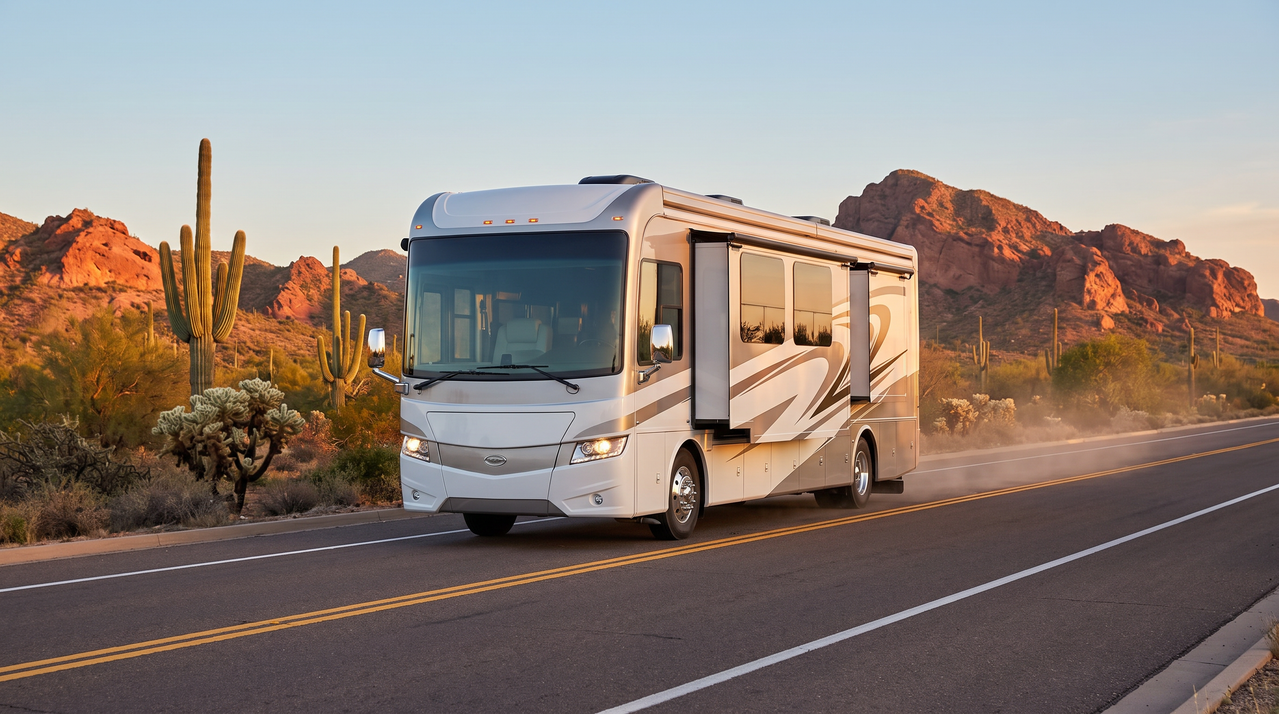
Recreational vehicles in Southern Arizona
Home / RV & Recreational

The fun stuff is barely covered.

Your auto policy follows the trailer only while it's hitched. Your homeowners policy stops at the driveway. RVs, boats, and toys need their own coverage, and it costs less than you'd guess.

25/50/15
Required On Motorhomes
Unhitched
When Auto Coverage Stops
$300k
Typical Marina Requirement
15 min
To a Real Quote
The Quick Answer

Motorhomes are registered vehicles, so Arizona requires the same 25/50/15 liability it requires of a car. Travel trailers and fifth wheels don't need their own liability, because your tow vehicle's policy extends while hitched, but that policy won't pay for damage to the trailer, its contents, or anything that happens while it's unhitched, which is most of its life. Campsite incidents need vacation liability, since auto liability is built for driving. Live in the rig more than about six months a year and you need a full-timer's policy, not a recreational one. Boats aren't required to be insured by Arizona law, but marinas commonly require around $300,000 in liability with the marina named as additional insured, and lenders require physical damage. Arizona does not require a boater education card, though registration with AZGFD is required and age limits apply to young operators. Raquel Jimenez Insurance in Tucson quotes all of it free at (520) 889-5766.

Motorhomes
25/50/15 liability required
Trailers
Covered only while hitched
Boats
Marina requires it, the state doesn't
Free quotes
(520) 889-5766
RV & Recreational, The Short Version

Two policies you already own. Neither one covers the toys.

Here is the assumption that costs people money. The RV is a vehicle, so the auto policy has it. The boat lives at the house, so the homeowners policy has it. Both feel reasonable. Both are mostly wrong.

Your auto policy does extend liability to a travel trailer, but only while it is hitched, and only for damage you cause to other people. It pays nothing for the trailer itself, nothing for what is inside it, and nothing at all once you unhitch, which is exactly where the trailer spends most of its existence. Your homeowners policy extends a little coverage to small, low-powered craft, generally under 26 feet and often only on your own property. A kayak, fine. Anything with a real motor, no, and the liability side is worse than the property side.

The good news is that this is a cheap problem. Recreational coverage is one of the least expensive things in insurance, and it usually bundles with your auto and home policies for a discount that softens the whole bill.

The bad news is that Arizona adds its own wrinkles. Wildfire makes a stored RV a total loss risk in a season when you are not even using it, which is exactly when owners are tempted to cancel the policy. Marinas here have their own insurance demands before they will hand you a slip. And Arizona doesn't require a boater education card, though taking the course usually earns a discount. None of it is complicated once someone walks you through it, and that is a fifteen-minute phone call.

What actually covers the toys. And what quietly doesn't.

Different machines, different rules. The pattern is the same: the required part is small and the useful part is optional.

Required by law
25/50/15

Motorhome Liability

A motorhome is a registered vehicle, so it needs the same liability minimum as a car. Worth going well above it: a forty-foot rig at highway speed does not produce small accidents, and the state minimum was not built with 30,000 pounds in mind.

Strongly recommended
Comp & Collision

Physical Damage

Repairs or replaces your rig. Required by any lender on a financed RV, and the only thing standing between wildfire, theft, or a falling branch and your wallet. Arizona leads the nation in vehicle theft, and RVs are not exempt.

Ask about this
Vacation

Vacation Liability

Covers incidents at the campsite, where auto liability was never designed to go. The tripped hookup cord, the dog, the awning. Some policies include a token limit, some include none, and some campgrounds ask you to carry it.

If it's home
Full-Timer

Full-Timer's Coverage

Once the rig is your residence for more than about six months a year, a recreational policy is the wrong product. This replaces what your homeowners policy used to do: real personal liability, guest medical, and belongings limits that match reality.

Read this line
TLR

Total Loss Replacement

The alternative to being paid depreciated value on a fast-depreciating asset. On a newer rig, TLR replaces it with a comparable new one instead of writing you a check that does not clear the loan. The most consequential line on the policy.

Off-season
Storage

Storage Coverage

The right answer instead of cancelling for the winter. Keeps comprehensive alive against fire and theft while suspending what you are not using. Cancelling saves less than you think and creates an insurance-history gap that raises what you pay later.

Not covered
Unhitched

Your Trailer, Most Of The Time

Auto liability follows the trailer while hitched and covers only what you damage. The trailer itself, its contents, and every hour it spends parked or stored are not your auto policy's problem. This is the most common gap we find.

Not covered
26 ft +

Your Boat, On Homeowners

Homeowners extends to small, low-powered craft, usually under 26 feet with horsepower caps, often only on your property. Kayaks yes. Anything with an engine, no, and it will not answer a liability claim out on the water at all.

Watch this
Cleanup

Fuel Spill & Wreck Removal

If your boat sinks, removing it is your bill. If fuel escapes, the environmental cleanup is your bill. Neither has anything to do with what the boat was worth, so a total loss can still cost you. Marinas name these specifically for a reason.

Got a trailer you assumed was covered?

Most people do. It takes about five minutes to find out what your auto policy actually does for it, and it is free either way.

RVs, Motorhomes & Trailers

An RV is a vehicle and a house. Insure both halves.

That dual nature is the whole reason RV insurance is its own product rather than a line on your auto policy. Get the vehicle half wrong and you are underinsured on the road. Get the house half wrong and you are underinsured everywhere you park.

Motorhomes versus trailers

A motorhome is a registered motor vehicle, so Arizona requires 25/50/15 liability, the same as a car. Insurers must offer uninsured motorist coverage and you can only decline it in writing. Given that a Class A can weigh 30,000 pounds, the state minimum is a starting point, not a plan.

A travel trailer or fifth wheel is not self-propelled, so no separate liability policy is required and your tow vehicle covers the hitched liability. What people hear is "covered." What is true is "covered for one narrow thing during one narrow window." The trailer's own damage, its contents, and every unhitched hour need physical damage coverage of their own.

The parked half nobody prices

When the rig stops moving it becomes a residence, and residence risks show up: guests, dogs, awnings, hookups, and everything inside. Vacation liability handles the campsite. Personal belongings coverage handles the contents, and the default limit is usually modest, often a couple thousand dollars, which is nothing next to what people actually travel with once you add electronics, gear, and tools.

If the rig is the residence, everything changes. Six months a year is the usual line, and past it a full-timer's policy is the correct product because there is no homeowners policy standing behind you anymore. Arizona's housing costs have pushed real numbers of people into full-time RV living, and most of them never switched off the recreational policy they bought for weekends.

Two Arizona specifics

First, wildfire and storage. Your rig is most exposed exactly when you are not using it: parked, unattended, often near brush. Comprehensive is what answers that, and it is the coverage people drop to save money in the off-season. Use a storage option instead, which keeps comprehensive alive and suspends the rest. And do not cancel outright, because gaps in coverage history follow you into your next policy's price.

Second, roadside assistance sized to the vehicle. Ordinary auto roadside will not tow a forty-foot Class A. If your plan cannot physically move your rig, you do not have roadside assistance, you have a phone number.

Boats, PWC & Off-Road

Arizona won't make you insure the boat. The marina will.

Technically, recreational boat insurance is optional in this state. Practically, the people you need things from have their own rules, and they are not negotiable.

Who actually requires it

Marinas want proof of liability before they rent you a slip, commonly in the neighborhood of $300,000, and they frequently want to be named as an additional insured, with fuel spill and hull coverage called out by name. Lenders require physical damage on a financed boat and will want to be the loss payee. Some events and waterways want proof before you launch.

The other half is the part that has nothing to do with paperwork. If your boat sinks, wreck removal is your responsibility. If fuel gets out, environmental cleanup is your responsibility. Neither of those bills is capped by what the boat was worth, which is why "it's an old boat, it isn't worth insuring" is a mistake in reasoning rather than a budget decision.

Boater education, and the discount hiding in it

Arizona does not require boater education for recreational operators on Arizona waters. A state-approved safety course is still worth taking: most carriers discount for it, and the card is recognised in states that do require one.

Worth knowing: the same safety course that satisfies the law often earns you a discount on the policy. Rarely do the state and your premium agree on something this cleanly.

Jet skis, ATVs, and the rest of the garage

PWCs follow the same rules as boats and deserve more respect than they get. They are fast, twitchy, and routinely handed to a friend who has never operated one, which is a liability profile out of all proportion to the price of the machine.

ATVs, dirt bikes, and side-by-sides need their own coverage too. The garage does not make them a homeowners item once they leave the property, and often not even on it. Coverage handles trail liability, theft (toys on trailers disappear), and the trailer itself. Tell us where you actually ride, because the dunes, private land, and public OHV areas are not identical to an underwriter. Street bikes are a different animal entirely and belong on a motorcycle policy.

Everything with a motor, on one bill.

RV, boat, the toys, the cars, the house. Bundled properly it is usually cheaper than the pieces, and one person can see the whole picture.

However you get out there. We'll cover it.

Weekend trips, full-time living, a boat in the Delta, quads on a trailer. Each one is a different policy.

Tell us what's in the driveway and what's on the water.

We will tell you what is actually covered today, what isn't, and what it costs to fix. Fifteen minutes, free, no pitch.

RV & boat insurance in Tucson. And across Arizona.

Where you store it matters as much as where you take it. Tell us the ZIP and we will price the real thing.

RV, boat & recreational questions. Straight answers.

Is RV insurance required in Arizona?

For a motorhome, yes. It is a registered motor vehicle, so it needs the same liability Arizona requires of a car: 25/50/15, meaning $25,000 per injured person, $50,000 per accident, and $15,000 property damage. Insurers must also offer you uninsured motorist coverage, which you can decline only by signing a waiver.

For a travel trailer or fifth wheel, no. It has no motor, so the state does not require its own liability policy, and your tow vehicle's liability generally extends to it while hitched. That is a much smaller sentence than it sounds. Read the next question.

Doesn't my auto policy already cover my travel trailer?

Only the part you are least likely to need. Your auto policy's liability follows the trailer while it is hitched, covering damage you cause to others. That is where the coverage stops.

It does not cover damage to the trailer itself, the contents inside it, or anything that happens while it is unhitched, which is nearly all of its life. Parked at the campsite, sitting in storage, or standing in your driveway when a tree comes down: none of that is your auto policy's problem. If the trailer is worth more than a few thousand dollars, it needs its own physical damage coverage.

What is vacation liability, and do I need it?

It covers what happens when the RV stops being a vehicle and starts being a place you live. A visitor trips over your hookup cord. Your dog bites someone at the site. Your awning takes out the rig next to you.

Auto liability is not designed for any of that, because it is built for driving. Vacation liability is the piece that fills the gap while you are parked. Some policies include a small default limit, some include none, and some Arizona campgrounds ask you to carry it. If you spend real time parked at state parks or along the coast, check that the limit matches how you actually camp.

Do I need a full-timer's policy?

If you live in the RV for more than about six months a year and no longer have a house with a homeowners policy behind you, yes. A recreational policy is the wrong product and it leaves real holes.

A full-timer's policy does the jobs your homeowners policy used to do: broader personal liability that follows you rather than just the campsite, medical payments for guests, and personal property limits that reflect the fact that everything you own is in there. Arizona's housing costs have moved a lot of people into full-time RV living, and most of them are still carrying the recreational policy they started with. If the rig is your home, tell us.

If my RV is totaled, what does the policy actually pay?

It depends on one line most owners never read. Actual cash value pays the depreciated market value at the time of the loss, minus your deductible. RVs depreciate quickly, so if you financed the rig, the payout can land well below what you still owe and the difference is yours.

Total loss replacement is the alternative on newer units: if it is totaled within a defined window, you get a comparable new RV rather than a depreciated check. It costs more and it is worth understanding before you need it rather than after. Ask which one your current policy uses. It is the single most consequential line on an RV policy.

Should I cancel my RV policy over the winter to save money?

Please don't. Two reasons, and both cost more than the premium you would save.

First, the risks that do not care whether you are driving are exactly the ones that happen while parked: theft, vandalism, hail, a falling branch, and in this state, wildfire. A stored RV in a fire-prone area is a total loss waiting for a bad week. Your homeowners policy will not pay for it sitting in your own driveway.

Second, cancelling creates a gap in your insurance history, and gaps affect eligibility, discounts, and pricing when you come back. The better move is a storage option: keep comprehensive in force while suspending the coverages you genuinely are not using. You save money without creating a hole.

Is boat insurance required in Arizona?

Not by the state. Arizona does not mandate insurance for recreational vessels. That question is almost always the wrong one, because somebody else is going to require it.

Marinas commonly require liability coverage before they will rent you a slip, frequently around $300,000, and they will often want to be named as an additional insured, with fuel spill and hull coverage specified. Lenders require physical damage coverage on a financed boat and will want to be listed as loss payee. Between those two, most Arizona boat owners are effectively required to carry it by the people they do business with, if not by the state.

Does my homeowners policy cover my boat?

Only at the very small end. Most homeowners policies extend limited coverage to small, low-powered craft, typically under 26 feet with horsepower limits, and often only while it is on your property.

A kayak or canoe is usually fine. Anything with a real engine is not, and the liability side is the bigger issue: hurt someone or damage a dock while out on the water and your homeowners policy is not answering that call. Anything meaningful needs its own policy.

Do I need a boater education card in Arizona?

No. Arizona does not require boater education for recreational operators on its own waters, unlike some neighbouring states. You do need to register a motorized watercraft with the Arizona Game and Fish Department, and age limits apply: generally a child under 12 cannot operate a vessel over 8 horsepower unless a qualifying adult is aboard. A NASBLA-approved course is still worth taking, since most carriers discount for it and it is recognised in states that do require a card.

It requires passing a state-approved boater safety course, and you carry the card on board and show it on request. It is not insurance, but it is worth knowing about, and taking a safety course often earns you a discount on the policy too. Registration is separate: motorized vessels and sailboats over eight feet register with the Arizona DMV.

What are fuel spill liability and wreck removal, and why does my marina want them?

These are the boat coverages nobody thinks about until they are the whole claim. If your boat sinks, someone has to remove the wreck, and you are that someone, especially in shallow or ecologically sensitive water. If fuel escapes, you are looking at an environmental cleanup and potential fines that are not small.

Neither cost has anything to do with what your boat was worth, which is why a total loss can still leave you writing checks. Marinas know this, which is why their insurance requirements often name these specifically. Make sure your policy actually includes them rather than assuming.

Do I need insurance for a jet ski or personal watercraft?

Same rules as boats: not required by Arizona law, absolutely required by lenders and most marinas and launch facilities. And practically speaking, PWCs are fast, highly maneuverable, and operated by a rotating cast of guests who have never driven one.

That combination produces liability claims at a rate well out of proportion to the size of the machine. Coverage is inexpensive. The claim of someone else's injury is not.

What about ATVs, dirt bikes, and side-by-sides?

Off-road vehicles need their own coverage, and the common assumption that they are covered by the homeowners policy because they live in your garage is wrong once they leave the property, and often wrong on it.

Coverage handles liability if you injure someone or damage property on the trail, physical damage and theft (which is common with toys on trailers), and the trailer hauling them. Tell us what you actually ride and where, since coverage differs between the dunes, private land, and public OHV areas. If it is a street bike rather than a trail machine, that is a motorcycle policy.

Still have questions? Call (520) 889-5766. We will give you a straight answer.
Recreational vehicles in Southern Arizona

Go enjoy it.
We'll handle the boring part.

Tell us what you drive, tow, launch, and ride. We will build the coverage around how you actually use it and quote it in about 15 minutes.